Suggested Topics

Please Tweet with any suggested topics for future blogs.

Saturday, February 22, 2014

National Carrier Spectrum Holdings - Top 100 CMA Markets

AllNet Labs is now offering a monthly spectrum report summarizing the spectrum holdings for the National Carriers (Verizon, AT&T, Sprint, and T-Mobile).  To develop this report, AllNet Labs takes the spectrum outputs at a county level from its Spectrum Analysis Tool and applies a county population weighting before averaging all of the counties within a Cellular Market Area (CMA).  Data is available for all 733 CMA markets, but the standard report is formatted for the 100 most populated CMA markets.  This report is delivered as an Excel spreadsheet, with both summary and detailed views.  In the summary view (Figure 1), only the total spectrum holdings for each carrier are displayed.
Figure 1
By selecting the [+] in the upper margin to the right of AT&T spectrum holdings we can reveal  AT&T’s spectrum distribution by band.  This expanded view is seen below as Figure 2.
Figure 2
AllNet Labs has added a proposed transaction data set to the Spectrum Analysis Tool.  With this data set, we are able to simplify hundreds of license transfers at the FCC into the net effect for wireless operators.  All of the transactions are captured from the FCC Daily Digest and each license is updated at the callsign, county, and frequency levels.  Using this proposed transaction data, a matrix of the national carrier’s proposed spectrum holdings is created (Figure 3).  
Figure 3
 By selecting the [+] signs in the upper margin, a carrier’s spectrum holdings by band can be detailed.   (Figure 4).
Figure 4
The last matrix in this report summarizes the differences between the proposed spectrum holdings and the current spectrum holdings.  This highlights areas that are affected by proposed transactions.  The example shown uses data from the December 2013 Spectrum Analysis Tool.    The proposed transactions for December 2013 were transactions announced prior to 12/1 which included AT&T’s purchase of Leap as well as many other minor transactions.  The effect of that transaction as well as other more minor transactions is easily seen in Figure 5, with AT&T increasing their spectrum holdings in 6 of the 15 CMA markets listed.
Figure 5
 To see the changes at the spectrum band level of detail, select the [+] in the upper margin as described before.  As seen in Figure 6, AT&T’s increase in spectrum was the result of increases in AWS and PCS spectrum, which matches the known spectrum that Leap will bring to AT&T.
Figure 6
 AllNet Lab's Spectrum Analysis Tool is an Excel based product which allows users to visualize and analyze the current spectrum ownership for all of the mobile carrier and satellite frequency bands at a county level for all 50 states and US territories.  The Spectrum Analysis Tool includes 15 color-coded spectrum holders and over 600 additional identified carriers.  More information can be found at www.allnetlabs.com.

Monday, November 25, 2013

700 MHz A Block Owners (Map) and Top 20/50 Analysis

With the recent industry press indicating that T-Mobile was positioning its self to purchase Verizon's 700 MHz A Block, I decided to dive into the Spectrum Analysis Tool to see what kind of geographic area Verizon's licenses would provide T-Mobile with low band spectrum.  
Clearly it would not be a spectrum purchase to provide coverage in rural areas since it doesn't address the rural areas in the western United States with the exception of western Colorado.  Looking at it on a Cellular Market (CMA) basis, this spectrum would provide T-Mobile with low band spectrum in all 15 of the Top 20 markets but only 25 of the Top 50 markets.  This includes both the Verizon spectrum and T-Mobile's 700MHz spectrum acquired from MetroPCS.

To acquire the remaining 700 MHz A block spectrum in the Top 20 markets, T-Mobile will need to be talking to:

Leap - Chicago
US Cellular - St. Louis
McBride Spectrum - Pittsburg
Cox - San Diego
Vulcan - Seattle

Tuesday, November 19, 2013

LTE Band Class Updates

As I was completing my research for an upcoming blog on LTE Carrier Aggregation, I found that my previous LTE Band Class reference sheet was missing some of the more recent Band Class updates, so I decided to share my new reference document with a few comments.

FDD Band Classes:


The first notable band class addition in Band 30.  This band class creates a definition for FDD operation in the WCS (2.3GHz) band which was previously defined only for TDD operation.
From the Spectrum Grid view of the Spectrum Ownership and Analysis Tool, you can see that Band 30 does not include the 5MHz channels that AT&T purchased to essentially become guard bands for the Satellite Audio guys.  This will provide AT&T with a 10x10 LTE channel on a market by market basis, as they resolve the remaining ownership issues in the WCS band.

The next two band classes are not new, but I previously skipped over these band classes because I didn't fully understand their frequency breaks.

Band 26
Previously I thought this was a specific band for Sprint  IDEN operation that is adjacent to the cellular band.  This is the band where Sprint is placing their 2nd LTE channel (5 MHz) and a CDMA channel (1.23 MHz). Looking at the frequencies in detail, the band class covers the IDEN spectrum and the adjacent cellular spectrum.

This is similar to Sprint's Band 25 which includes all of the PCS band plus their G block spectrum (but not the H block).


So you would think that all of the North American carriers could standardize to Band 25 for PCS operation and Band 26 for Cellular. Using the latest iPhone 5s LTE band support,
you can see the Verizon, T-Mobile, and AT&T iPhone's support Band 2 and 25 for PCS, but only the cellular band (Band 5).  Sprint iPhone 5s includes,
both Band 2 and 25 for PCS and Band 5 and 26 for cellular.

Band 10:
This is referenced as the AWS extended band and you can note from above that it is not currently applied to smartphones like the iPhone 5s.  This band class seems to be a preparation for the future use of the AWS-2 and AWS-3 spectrum and the government shared use band that are both adjacent to the existing AWS spectrum band.  Here is how the downlink looks in the Spectrum Ownership Analysis Tool:
Note that Band 10 does not cover the entire band contemplated for AWS-3, nor does it include Dish's Band 23.  For the uplink:

This again depicts that Band 10 is not currently set to include the entire shared government opportunity.

TDD Band Classes:
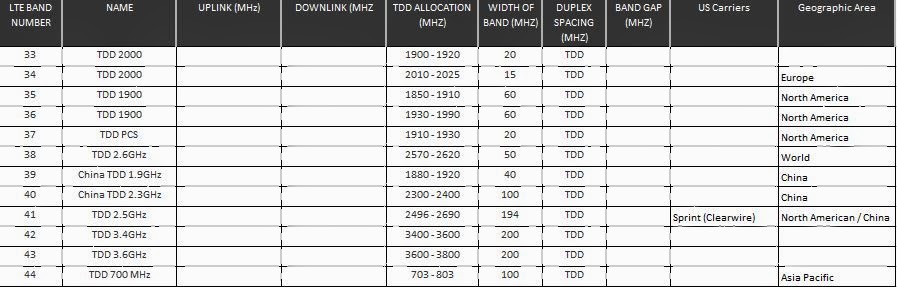
Here is the reference sheet the TDD band classes.

On this reference sheet I hadn't looked closely at band classes 35, 36, and 37.  I had always focused on the 2.3GHz and 2.5GHz as the only bands that were designated for TDD support in North America.  These three band classes create 140MHz block of spectrum that could be for TDD deployment.  Here is how these bands appear in the Spectrum Ownership Analysis Tool:
I'm not sure what the history is on these band classes, but they would support TDD operation in both the PCS uplink and downlink bands as well as in the 20 MHz between the bands.  Since the PCS frequencies are highly deployed, I would consider it very unlikely to see TDD systems in this band in the near future, and I doubt that the PCS band is authorized for TDD operation.  It will be interesting to see whether any of the wireless carriers begin to look this direction.  With Sprint stepping out of the H block auction, they seem to be signalling that TDD operation is more important to them and the Band 37 block (including Sprint's G block) could be the reason why Dish is pushing forward in the H block auction.  Please comment if you are aware why the 3GPP has included these 3 TDD band classes.

Wednesday, November 13, 2013

Sprint Exits H Block Auction, Why?, timing...

Although it surprised the wireless industry a bit, it does make sense that Sprint saw a declining value in the H block spectrum.  Acquiring that spectrum would have allowed Sprint to expand their primary LTE Channel from a 5x5 channel to a 10x10 channel. In terms of Mbps, from 37 Mbps per sector to 73 Mbps per sector.  If this could be added to the network today, it would bring Sprint to about par with the other 3 national carriers.  The problem is timing.  It will be mid-2014 before the spectrum will be awarded to the auction winner, but prior to receiving the spectrum, the high bidder could start the 18-24 month process to get the LTE band classifications changed.  Sprint would either have expanded the frequencies for their band 25 or requested a new band classification that would include all of the old PCS block, the PCS G block, and the PCS H block.  With the standards body work, including carrier aggregation, it would likely by early 2016 before network upgrades would begin.  This coincides with their forecasted completion of Project Spark.  If Sprint completes this project on-time, they will have 38,000 sites that will be enabled with 40MHz of 2.5GHz spectrum, which could be a game changer.  This does seem to signal that Sprint doesn't think their PCS G LTE is particularly strategic.

Wednesday, November 6, 2013

Verizon St Louis Spectrum Purchase, Carrier Aggregation, and Competitive Landscape

It is interesting to look at the details of Verizon's spectrum purchase from US Cellular in the St Louis market area (EA-96).   Many industry sources talk about how purchase will provide 20MHz for Verizon's LTE.  While this is true, it should not be confused with Verizon deploying a 20 x 20 channel.  As can be seen from the Spectrum Grid view of AllNet Labs' Spectrum Ownership Analysis Tool, Verizon is purchasing the AWS B channel and previously owned the F channel.  Although Verizon will own 20 MHz of spectrum, it is not contiguous and until they can deploy Release 12 software code into their network, they will have to operate this spectrum as two separate 10 MHz channels.  Release 12 is likely a 2015 or maybe 2016 release since operators are either planning or deploying Release 10 currently. 

The industry talks alot about Carrier Aggregation (CA) but there are several facts that are not well understood.  First, Release 10 includes the functionality for carrier aggregation but the frequency band definitions for the US are not included until Release 11.  Another point that needs to be understood is that the initial definitions require that aggregated carriers be in contiguous blocks in different spectrum bands (inter-band) or in separate blocks but in the same band (intra-band).   For Release 11, only 2 carriers can be aggregated together.  For Release 12, Verizon has sponsored a work group that will allow 3 carriers to be aggregated, 1 from the 700MHz band and 2 different carriers from the AWS band.  Thus, Release 12 will be necessary for Verizon to aggregate their two AWS blocks of spectrum with their 700 MHz LTE.


The Spectrum Grid view is sorted by the EA geographical area which show that the AWS B and C licenses have not be dis-aggregated.  The A channel licenses do show discontinuity since they were originally auctioned as CMA licenses.  AT&T through their Leap purchase will strengthen their AWS ownership in this market.

To look at the competitive picture for spectrum in the St Louis market (EA-96) we can look at the 
Company By Band worksheet from the AllNet Labs' Spectrum Ownership Analysis Tool.  Looking first at Verizon, we can see the variety of spectrum depths across the EA that Verizon indicated in their FCC filing. Verizon will range from 62 MHz to 117 MHz depending on the county.  The only county that Verizon controls 117 MHz is Montgomery County, MO which is 40 miles west of St. Louis.  

Looking at the other carriers in this market we see that US Cellular will still control between 32 MHz and 69 MHz, while AT&T with their Leap purchase will control between 61 MHz and 105 MHz.


T-Mobile controls between 40 MHz and 60 MHz with two counties at 70 MHz and Sprint with their Clearwire purchase controls between 130 MHz and 242 MHz.  


Friday, October 18, 2013

Effect of WiFi Off-loading

For the past month I have been examining the effect of WiFi off-loading based upon my usage habits.  To do this leave WiFi turned off so my phone only receives data service from a commercial carrier network.  This was not a simple task because the Smartphone network optimizer will continue to request to have WiFi turned on and whenever you are using location services (Google+) not having WiFi provides a notification "to improve you location, please turn on WiFi".

My typical monthly data usage averages around 1.3 GB per month with WiFi enabled.  I travel infrequently and have WiFi both at home and work.  I think it is important to note that my work WiFi doesn't block YouTube, Pandora, Facebook, or WatchESPN, but I typically use a WiFi only tablet for music streaming or the watching a major sporting event e.g The America's Cup or the MBL playoffs.

In the month of September, I ran 5.7 GB of data in what I consider to be a typical work month.  What this equates to is 3.4 GB of data that was off-loaded from the carrier network to the WiFi network for which I also pay.  Another way to look at it is that my carrier only sees 1/3 of my usage.

Using some of the wholesale data rates that have been thrown around in the trade press, $5/GB; the cost to support my data usage through a WiFi Off-loading provider would be $17/month.  If I am paying my carrier $30/month for my data usage and they pay a Wi-Fi off-loading provider $17/month, they only end up with $13/month to offset their operational expenses (site leases, backhaul costs, employees...)

When you consider the "true" smartphone usage and where the majority of that traffic is handled today, it is clear why cellular carriers have been reluctant to purchase wholesale access to data or a WiFi off-loading partner.

Check back next month.  After my billing period closed, I spent the weekend out of town, so streaming two college football games on Saturday (Dish Anywhere) and 1 NFL game on Sunday will all be part of my October usage.  With just 9 days on my billing cycle, I have already consumed 3.3 GB.


Wednesday, October 16, 2013

Verizon's AWS Deployments

With the news that Verizon is beginning to turn up some of their AWS spectrum with LTE, I will examine the spectrum available for those LTE deployments in the Top 5 CMAs with the Spectrum Ownership Analysis Tool.

New York:

Verizon clearly holds 20 MHz of AWS spectrum.  To see how this spectrum will affect their total LTE capacity I have evaluated the LTE channels that Verizon can deploy based on their stated direction.  Based upon Verizon's stated direction I have eliminated any 700 MHz 5x5 LTE channels, any cellular LTE channels, and any PCS LTE channels.


With this analysis, it is evident that Verizon will top out at 223 Mbps across all of the counties in the New York CMA.

Los Angeles:


 In Los Angeles, I would expect Verizon to be deploying a 10 MHz LTE channel until AT&T has shifted its LTE usage of this AWS channel to it "new" 700MHz B band holding.


 At this point Verizon is limited to 2 - 10x10 channels or 146 Mbps throughout the Los Angeles CMA.

Chicago:


In Chicago, Verizon holds a 20x20 AWS channel.


This combined with Verizon's 700 MHz C-band (10x10) channel will provide 223 Mbps throughout the Chicago CMA.

Philadelphia:


In Philadelphia, the largest channel Verizon can form is a 10x10 channel.  When AT&T gets control of the Leap spectrum assets, I would expect a three-way spectrum trade to allow Verizon, T-Mobile, and AT&T to rationalize their AWS spectrum positions.


For the throughput analysis, the additional 5x5 channel that Verizon can form in the AWS frequency band is included with the 2 - 10x10 channels (AWS and 700) for a total metro throughput of 183 Mbps.

Detroit:


In Detroit, Verizon can again form a 20x20 AWS channel.


In the Detroit CMA, Verizon can achieve a metro through put of 223 Mbps.